
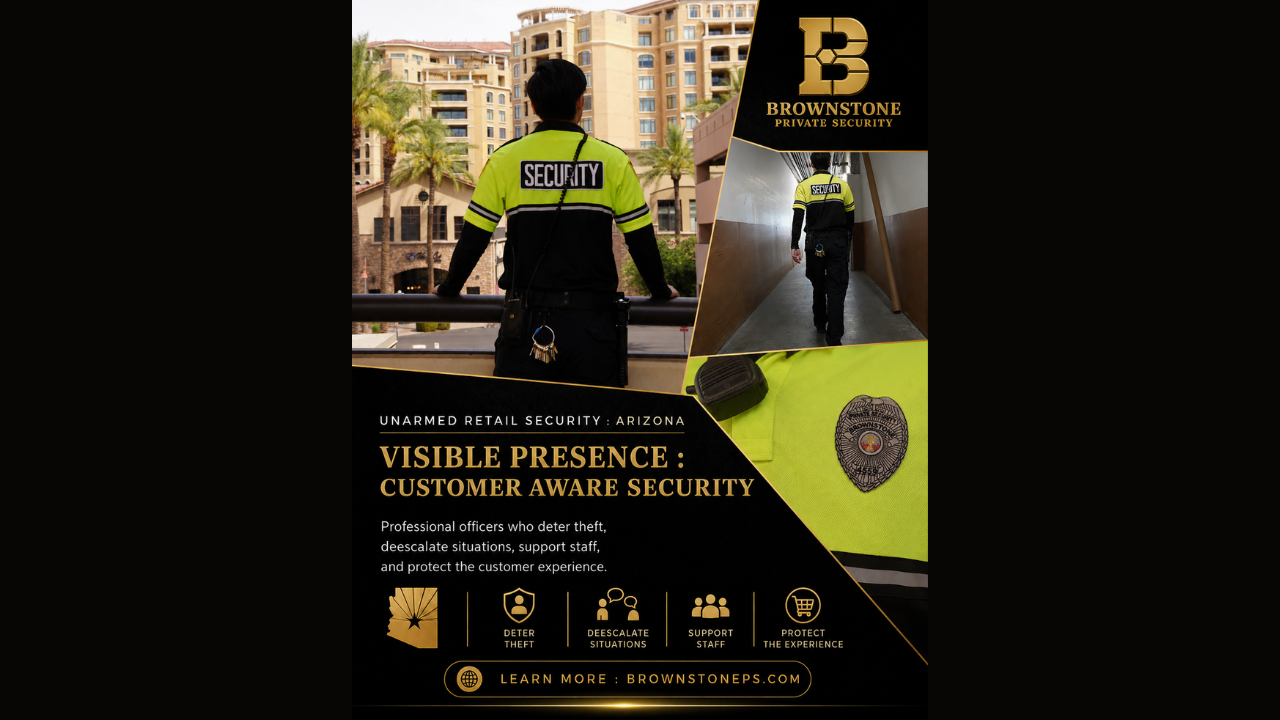
Retail security has changed.
For years, many businesses viewed security primarily as a response function: place an officer near the entrance, monitor cameras, and react when something happens.
That approach is no longer enough.
Modern retailers are balancing theft, repeat offenders, organized retail crime, employee safety, customer expectations, open floor plans, high value merchandise, parking lot activity, and increasingly complex operating environments. At the same time, most retailers cannot afford to make legitimate customers feel as though they are entering a secured facility rather than a store.
Effective retail security exists somewhere between those two extremes.
It should be visible enough to deter problems, capable enough to respond when necessary, and professional enough to remain part of the customer experience rather than interfere with it.
That is where well trained unarmed retail security officers can provide significant value.
Retail Security Is an Operational Function
Security is often discussed in terms of incidents.
The better question is what happens during the thousands of hours when there is no major incident.
A professional retail security officer is continuously observing the environment, identifying unusual behavior, maintaining awareness of entrances and exits, supporting employees, documenting activity, communicating concerns, and creating a visible deterrent.
Those functions contribute to the larger operation.
For retailers, shopping centers, mixed use developments, and commercial properties throughout Arizona, the objective should not simply be to place a uniform at the door.
The objective should be to create a security presence that improves control of the environment.
Brownstone Private Security provides armed and unarmed security, access control, surveillance, and related protective services throughout Arizona, with customer service positioned as an important part of its operating model.
Why Visible Security Still Matters in Retail
Technology has dramatically improved retail security.
Modern operations may use video surveillance, analytics, electronic article surveillance, access control systems, point of sale data, license plate recognition, alarms, and centralized monitoring.
Those systems are valuable.
But technology and physical presence solve different problems. A camera can record an individual entering a location.
A trained officer can recognize that the individual has entered repeatedly without purchasing anything, observe behavioral changes, alert management, reposition strategically, document activity, and respond if the situation escalates.
This is why strong retail security strategies increasingly use layers rather than relying on a single control.
The National Retail Federation’s 2026 research found that retailers experienced a 12.4% decline in shoplifting incidents and an 8.1% decline in merchandise theft between 2024 and 2025, progress NRF attributed in part to retailer investments in security, technology, and employee training. At the same time, repeat offender activity and organized retail crime remain significant concerns, demonstrating that the threat is evolving rather than disappearing.
The lesson is important:
Retail security works best when people, procedures, intelligence, and technology reinforce one another.
What Should an Unarmed Retail Security Officer Actually Do?
The answer depends on the property.
A luxury retailer in Scottsdale has different risks than a grocery store in Phoenix, a shopping center in Mesa, or a mixed use development in Tempe.
Post orders should reflect those differences.
However, effective retail security assignments commonly include several core responsibilities.
Maintain a Professional Visible Presence
Visibility changes behavior.
A properly positioned officer signals that the property is actively monitored while giving employees and customers a recognizable resource when assistance is needed.
Presence alone should never be confused with performance, however.
Effective officers remain engaged with their surroundings rather than simply occupying a post.
Observe and Identify Concerning Behavior
Experienced security officers should understand the environment well enough to recognize when something does not fit normal activity.
That may include repeated entry and exit activity, unusual attention to employees or cameras, coordinated behavior between multiple individuals, attempted access to restricted areas, aggressive conduct, suspicious vehicle activity, or other indicators requiring closer observation.
Security is often about identifying a developing situation before it becomes an incident.
Support Theft Deterrence and Loss Prevention
Retail security and loss prevention overlap, but they are not identical.
Loss prevention may involve detailed investigations, inventory controls, exception reporting, internal theft detection, and specialized apprehension policies.
Uniformed retail security provides another important layer: visible deterrence, observation, incident response, employee support, and documentation.
Brownstone also identifies loss prevention among the training available through its licensed training facility.
De Escalate Situations Before They Become Larger Problems
One of the most valuable skills in retail security is knowing when not to escalate.
Retail officers routinely interact with individuals who are frustrated, confused, intoxicated, emotionally distressed, confrontational, or unwilling to follow property policies.
Professional communication can often resolve an issue before physical intervention becomes necessary.
That requires judgment. It also requires training.
An officer who immediately increases tension can create additional risk for the retailer. An officer capable of maintaining authority while communicating calmly can help regain control without unnecessarily disrupting customers or employees.
Support Store Employees
Retail employees should not be expected to become security personnel simply because an incident occurs.
Having trained security available gives managers and associates a defined escalation point for safety related concerns.
That can include suspicious activity, aggressive customers, trespassing, disturbances, closing procedures, employee escorts, or situations where staff simply need an additional professional presence.
The Customer Experience Is Part of Retail Security
There is a misconception that stronger security automatically means a more intimidating environment.
It should not.
The best retail security programs recognize that a security officer is also part of the property’s public facing team.
Appearance matters. Communication matters. Body language matters. Positioning matters.
Knowing when to approach someone and when simply to observe matters.
A security officer who understands those principles can deter unwanted activity while still answering a customer’s question, helping an employee, directing a visitor, or professionally representing the property.
Brownstone’s stated operating values emphasize professionalism, respect, open communication, training, empowerment, customer service, and teamwork. Those principles are particularly relevant in retail environments where officers routinely interact with the public.
Unarmed Security vs. Armed Security for Retail Properties
One of the most common questions retailers ask is whether their location requires armed or unarmed security.
There is no universal answer.
For many retail environments, professional unarmed security provides the appropriate combination of visibility, deterrence, communication, and response capability without introducing an armed presence into normal customer interactions.
Other properties may have risk factors that justify armed coverage.
The decision should be based on an actual risk assessment rather than appearance or assumption.
Factors to evaluate include:
- Prior incidents and calls for service
- Type and value of merchandise
- Location and surrounding crime patterns
- Hours of operation
- Employee closing procedures
- Parking structure or parking lot exposure
- Number and location of entrances
- History of threats or violence
- Cash handling
- Client policies and insurance requirements
- Expected role of the security officer
The correct security model is the one that addresses the property’s actual exposure.
Retail Security Should Be Designed Around the Property
Two stores located five miles apart may require entirely different security strategies.
That is why Brownstone approaches security as more than simply filling hours.
A serious security provider should understand the property before determining how officers should operate.
Questions should include:
Where are losses occurring? When are incidents occurring?
Which entrances create the greatest exposure? Where do employees feel vulnerable?
What happens during opening and closing? What activity occurs in the parking lot?
What incidents repeatedly require management involvement? How does the client want officers interacting with customers? How are incidents documented and escalated?
These questions turn security from staffing into strategy.
Security Reporting Is More Important Than Most Businesses Realize
A professional officer should not simply handle an incident and move on. Documentation creates intelligence.
Over time, properly structured security reports can reveal patterns involving:
- Repeat offenders
- Incident times
- Specific entrances
- High risk merchandise
- Parking areas
- Employee concerns
- Trespassing
- Loitering
- Safety hazards
- Customer disturbances
- Recurring operational weaknesses
That information allows management to make better decisions.
It can influence staffing schedules, camera placement, lighting, merchandise positioning, access procedures, employee training, and communication with law enforcement.
Good security generates information.
Good security management turns that information into action.
Arizona Retailers Should Verify Licensing and Training
Private security is regulated in Arizona.
The Arizona Department of Public Safety oversees security guard and security agency licensing, registration, training requirements, and regulatory compliance. Businesses evaluating an Arizona security company should verify that the provider and personnel operating on their property meet applicable state requirements.
Brownstone Private Security identifies itself as Arizona DPS licensed and operates a training facility with in house certified instructors offering ongoing officer training, including loss prevention, management of aggressive behavior, workplace violence prevention, CPR, First Aid, AED, and site specific instruction.
Licensing should be the minimum.
The real differentiator is what happens after the license is issued.
What Retailers Should Look for in a Security Company
When comparing retail security companies in Phoenix or elsewhere in Arizona, price per hour should not be the only question.
A better evaluation includes:
Training: What training does the officer receive beyond minimum licensing requirements?
Supervision: Who verifies that officers are performing correctly?
Post orders: Are responsibilities specifically defined for your location? Appearance: Does the officer appropriately represent your brand and environment? Communication: How quickly can management reach the security company?
Reporting: What information will you receive from the field? Escalation: What happens when a significant incident occurs? Staffing: How are call offs and emergency coverage handled?
Customer service: Can officers interact professionally with employees, customers, tenants, and visitors?
Adaptability: Can coverage change as the property’s risks change? A lower hourly rate does not necessarily create a lower security cost.
Poor performance, absenteeism, weak communication, inadequate documentation, and inappropriate interactions can create far greater operational expense.
Building a Stronger Retail Security Presence in Arizona
The objective of retail security is not to transform stores into fortresses.
It is to create an environment where employees can work, customers can shop, management can operate, and potential offenders understand that the property is actively protected.
That requires more than a uniform. It requires presence.
Training. Communication. Judgment.
Accountability.
And a security provider that understands the difference between simply occupying a post and actively protecting an operation.
For Arizona retailers, shopping centers, commercial properties, and mixed use developments evaluating their current security coverage, Brownstone Private Security provides professional armed and unarmed security solutions built around the needs of the individual property.
Visible presence. Customer aware security.
Frequently Asked Questions About Retail Security in Arizona
Do retail stores need security guards?
Not every retail property requires the same level of security. Stores experiencing recurring theft, customer disturbances, trespassing, employee safety concerns, organized retail crime, parking lot issues, or high value merchandise exposure may benefit significantly from professional security coverage. A site assessment can help determine whether dedicated officers, scheduled coverage, surveillance, or another security model is appropriate.
Are security guards required to be licensed in Arizona?
Arizona regulates private security through the Arizona Department of Public Safety. Security agencies and guards performing regulated private security services must comply with applicable state licensing and registration requirements. Businesses should verify licensing when evaluating a security provider.
Should a retail store use armed or unarmed security guards?
It depends on the property’s risk profile. Many retail locations use unarmed officers for deterrence, observation, customer interaction, employee support, and incident response. Properties with elevated threats, high value assets, or documented violence may require a different security model. The decision should follow a site specific assessment.
What is the difference between a retail security guard and a loss prevention officer?
Retail security guards typically provide visible security, incident response, access awareness, employee support, and general deterrence. Loss prevention personnel may perform more specialized functions related to theft identification, investigations, inventory loss, internal theft, surveillance, and retailer specific apprehension procedures. Some properties use both functions together.
Do security guards prevent shoplifting?
No security measure can eliminate theft completely. A visible and attentive security presence can create deterrence, improve observation, accelerate response, support employees, and help identify patterns that may otherwise go unnoticed. Security is most effective when combined with appropriate technology, policies, employee training, merchandise controls, and reporting.
Can security officers help with organized retail crime?
Professional officers can contribute to an organized retail crime strategy by identifying suspicious or coordinated activity, documenting incidents, recognizing repeat offenders, preserving information, communicating with management, and supporting established law enforcement reporting procedures. Because organized retail crime frequently crosses individual stores and jurisdictions, documentation and information sharing are especially important. NRF continues to identify repeat offenders and organized theft networks as significant industry concerns.
Do security cameras replace retail security guards?
Generally, no. Surveillance systems provide valuable visibility and evidence, while officers provide real time observation, judgment, communication, deterrence, and response. Many effective retail security strategies combine physical security personnel with surveillance and other technology.
How many security guards does a retail property need?
There is no standard number. Staffing depends on square footage, entrances and exits, operating hours, customer volume, incident history, merchandise exposure, parking areas, officer responsibilities, and the property’s overall risk profile. An assessment should determine staffing rather than simply assigning a predetermined number of guards.
How much does retail security cost in Arizona?
Retail security pricing varies based on location, required hours, officer qualifications, armed or unarmed status, supervision, technology requirements, shift structure, risk level, and scope of duties. Businesses should evaluate the complete security model rather than comparing hourly rates alone.
What should I ask before hiring a retail security company?
Ask about Arizona licensing, officer screening, training, supervision, incident reporting, emergency escalation, replacement staffing, management availability, site specific post orders, quality assurance, and experience in customer facing environments.
A strong provider should be able to explain how the security operation will work at your property, not simply provide an hourly rate.
Does Brownstone Private Security provide retail security in Phoenix and throughout Arizona?
Brownstone Private Security is based in Phoenix and provides armed and unarmed security and related protective services for Arizona businesses, including shopping centers and other
commercial environments. Brownstone describes itself as a regional security firm with national resources and lists Arizona DPS license #1712572.


Leave A Comment