
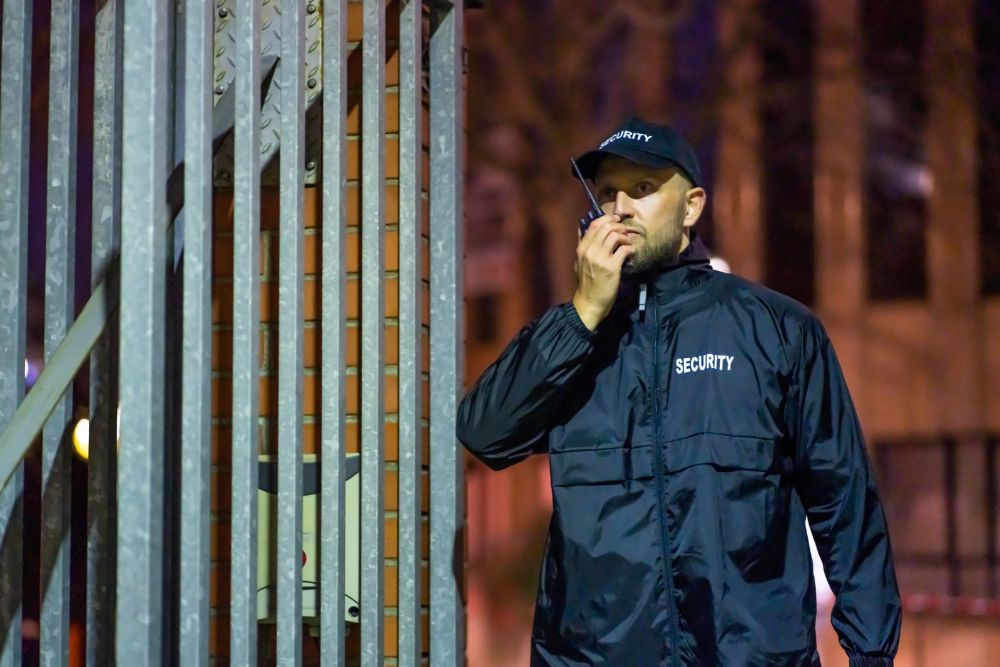
An unfamiliar visitor walks past reception toward the elevators. A frustrated customer refuses to leave a service counter. A contractor arrives at a loading entrance, but the employee who scheduled the work has already gone home.
Someone has to decide what happens next.
In a commercial building without clearly assigned security responsibilities, that decision may fall to a receptionist, a tenant employee, or a property manager answering a call from another location. They know their jobs. Managing an escalating confrontation or verifying an unexpected access request may not be one of them.
Professional security officers give those moments an established point of contact. For Arizona office buildings, business parks, and mixed-use commercial properties, their value is especially clear where public access meets private operations.
The Lobby Is a Working Security Post
A lobby has competing responsibilities. It must welcome the people who belong there while maintaining boundaries around the spaces beyond it.
Consider a multi-tenant office building in Phoenix. Visitors may be arriving for appointments with several businesses, each with different schedules and expectations. A confident introduction or a company name should not automatically grant access to every floor.
A security officer assigned to the lobby can verify a visitor through the approved process, contact the host, explain where to wait, and direct the visitor once authorization is confirmed. When a tenant is unavailable or an appointment cannot be verified, the officer follows an established procedure.
That consistency helps reception teams keep serving visitors without having to negotiate access exceptions themselves.
The quality of the interaction matters, too. A visitor who is unfamiliar with the building needs clear directions. An employee who forgot a credential needs a defined verification process. Neither situation benefits from an officer who substitutes attitude for judgment.
A well-run security post makes the building easier to navigate while keeping access decisions consistent.
Employees Need a Clear Way to Ask for Help
At a medical office reception desk, retail service counter, or commercial management office, a difficult conversation can change quickly.
The immediate need may be an officer nearby who can assess the situation, communicate calmly, and help staff follow the property’s response procedures. Employees should know how to request that support and what information to provide.
An officer’s assignment should establish when to involve management, when to disengage, and when emergency assistance is required. Staff should not have to wait for a situation to become severe before asking for help.
Professional conduct also means responding to observable behavior. A visitor’s appearance or unfamiliarity with the property is not, by itself, a reason for confrontation. Officers should focus on conduct, access authorization, and the rules they are assigned to apply.
For a business, this is an important service standard: employees receive support, and visitors are treated with dignity.
Deliveries and Contractors Need More Than a Wave Through
The front entrance may be carefully managed while the service entrance operates on familiarity.
A vendor recognizes an employee. A delivery arrives at an unusual time. A contractor says someone upstairs approved the work. Those situations require a workable verification process, particularly in buildings where several tenants share loading areas and corridors.
A commercial security officer can check approved schedules, contact the designated representative, record arrival information, and direct authorized personnel to the correct area. The scope should also identify any escort requirements and how departures are recorded.
In a Scottsdale office property or a Tempe mixed-use building, that coordination can help prevent one tenant’s delivery or maintenance work from opening access to another tenant’s restricted space.
The process should be quick enough for normal business and clear enough to handle an exception without improvisation.
Patrol Connects the Lobby to the Rest of the Property
A stationary post provides visibility at one location. Commercial properties also have stairwells, parking structures, service corridors, employee entrances, and other areas outside that post’s view.
Patrol responsibilities should identify what the officer is expected to observe and where management needs additional visibility. An officer may notice a door that is not latching, an obstructed walkway, a lighting outage, or activity in an area that should be closed.
Those observations become useful when they reach someone who can act on them.
For example, an officer finds that an employee entrance no longer secures properly. The immediate response follows site instructions. The report identifies the door, describes the condition, records the notification, and leaves a clear follow-up for management and the next shift.
Coverage must account for the officer’s location. If a lobby requires continuous staffing, that same officer cannot simultaneously patrol a parking garage. Post design should resolve that conflict before service begins.
The Last Employee Should Know How to Leave
An office building can remain active long after its main reception desk closes. A tenant works late. A cleaning crew arrives. A contractor finishes a repair. An employee waits near an entrance for a ride.
After-hours instructions should address the people who are legitimately still there.
An officer needs to know which areas remain accessible, how after-hours authorization is verified, and who can approve an exception. Employees need to know how to contact security and whether assistance to parking is included in the service.
Where escorts are offered, define how they are requested and how other assigned posts remain covered. A service should be supported by the staffing plan before employees are told to rely on it.
For Arizona properties with outdoor parking or multiple detached buildings, planning should follow the actual route people take from their workplace to their vehicle.
Measure the Work Behind the Uniform
A commercial security program should give management evidence of how the assignment is being performed.
Useful measures include whether scheduled posts are covered, access procedures are followed, patrols are documented, and significant issues reach the appropriate contact. Review whether unresolved conditions carry forward between shifts and whether repeated concerns receive attention.
A building may have few incident reports and still have a recurring problem with a service door. Another may generate frequent reports because an attentive officer is identifying issues that previously went unnoticed.
Look at the substance of the work. Are the observations specific? Are actions appropriate? Does management know what requires a decision?
Those questions make a service review more useful than counting reports alone.
Frequently Asked Questions About Commercial Security Officers
What does a security officer do in a commercial building?
Duties may include visitor verification, access control, patrols, employee assistance, contractor coordination, and incident reporting. The assignment should specify responsibilities, coverage hours, and escalation procedures for that building.
Should a commercial property use armed or unarmed security officers?
The choice should follow an assessment of the property’s risks, activities, public interaction, and required responsibilities. Armed coverage is a specific operational decision. The presence of a firearm does not replace training, sound judgment, or effective site procedures.
Can one officer cover the front desk and patrol the property?
An officer can perform both duties at different times if the coverage plan allows it. If the front desk must remain continuously staffed, management needs a separate arrangement for patrols, breaks, and incidents elsewhere on the property.
How are on-site officers different from mobile patrol?
On-site officers are assigned to a particular property during contracted hours. Mobile patrol typically provides visits rather than a continuous presence. A building with ongoing visitor verification has different coverage needs from a property requiring periodic exterior checks.
Can security officers help with disruptive visitors?
Within their training and assigned responsibilities, officers can communicate expectations, use de-escalation techniques, notify management, and request emergency assistance when needed. The property’s procedures should establish clear limits and escalation steps.
What information helps a security company recommend coverage?
Provide the building’s hours, layout, tenant mix, public access points, contractor activity, and recurring concerns. Explain which posts must remain staffed and what employees expect from security. Those details help define an assignment that can actually be delivered.
Give Your Commercial Property a Clear Point of Contact
Commercial security works best when the people in the building know where to turn and the officer knows what to do next.
Brownstone Security provides professional security services for Arizona properties. If your building needs a dedicated presence, stronger access procedures, or better support for employees and tenants, start with the situations your team currently handles without a clear security contact.
Contact Brownstone Security to discuss commercial security officer coverage for your Arizona property.


Leave A Comment